At Cementis, innovation goes far beyond anticipating market trends. It is about designing the sustainable foundations of our islands, day after day. Facing the unique climatic and environmental challenges of our region, our laboratories transform cutting-edge science into concrete solutions to build a greener and more resilient future, perfectly adapted to our tropical environment.
To step behind the scenes of this transformation, we sat down with Dr Binyu, Head of Innovation of the Cementis Group. From scientific precision and green commitments to upcoming industrial scale-ups, she opens the doors to her laboratories and shares her vision for the future of construction.
Hello, Dr Binyu. Could you briefly share your background and what drew you to a career in construction materials?
I completed a Master’s degree in Sustainable Urban Development at the Hong Kong Polytechnic University, followed by a Doctoral degree in Civil and Environmental Engineering. During my time on campus, I spent several years in the concrete laboratory, where I built my core competency in science-oriented research for construction materials. After my studies, I worked in research institutions and environmental tech companies, where I began putting theory into practice, with a strong focus on incorporating recycled materials into green construction products.
As Head of Innovation at CEMENTIS, what does your day-to-day work actually look like?
I manage three distinct laboratories. Firstly, the Quality Control (QC) lab, where we perform routine tests on random samples to ensure that all our products placed on the market are fully compliant.
I also oversee the Research & Development (R&D) lab, whose mission is to analyse and characterise raw materials as well as finished products. The goal is to better understand the scientific mechanisms influencing their performance and to identify avenues for improvement and innovation.
Thirdly, I look after the concrete lab, which bridges our cement products with our clients’ practical applications. There, we evaluate formulation performance under real-world conditions to guarantee optimal effectiveness on site.
In parallel, I also initiate and lead research projects beyond our routine testing. For instance, we are currently wrapping up an exciting R&D project funded by the Mauritius Research and Innovation Council (MRIC), in collaboration with international partners. This project paves the way for an eco-friendly green mortar specifically engineered for marine environment applications.
Our tropical climate brings high humidity, heat, and coastal air. How do these conditions typically affect construction materials?
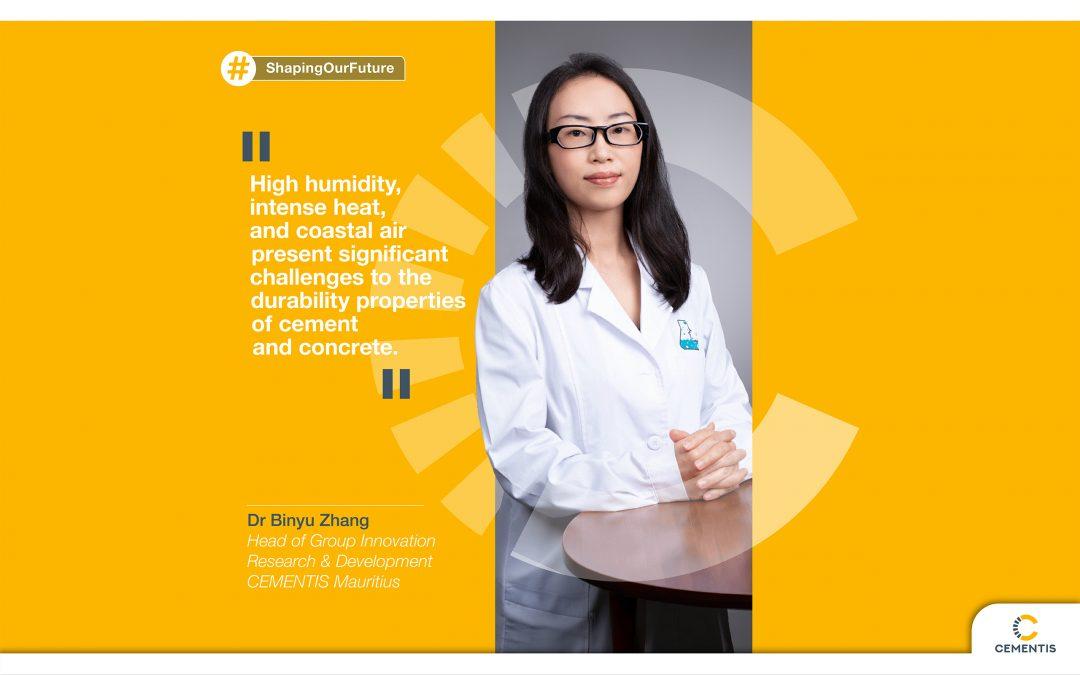
High humidity, intense heat, and coastal air present significant challenges to the durability properties of cement and concrete. To counter this, we are actively developing low-carbon cement and mortar products with enhanced durability properties. By replacing a portion of Ordinary Portland Cement (OPC) with Supplementary Cementitious Materials (SCMs) such as slag, fly ash, or basaltic filler, we not only reduce CO₂ emissions but also significantly enhance the materials’ long-term resistance to harsh marine environments.
What are the key testing and validation stages a Cementis product goes through in the lab before it hits the local market?
First and foremost, we ensure absolute compliance with international standards, whether BS EN, MS, ASTM, or others. On top of that, we push our testing further to align with our clients’ real-world needs, aiming to deliver products that benefit our islands both environmentally and economically.
How does the lab ensure that Cementis products perform reliably and maintain their mechanical strength under our local conditions?
We send our products to the MSB (Mauritius Standards Bureau) for regular external testing while running simultaneous internal tests to cross-check and validate our results. Our primary laboratory equipment is regularly calibrated by both the MSB and our suppliers to ensure absolute accuracy. Recently, we also joined a cross-testing program with other laboratories, which allows us to test our methods on standard cements and reconfirm the accuracy of our daily analyses.
Without giving too much away, what upcoming technical trends or innovations excite you the most for the future of Cementis?
Our core focus is sustainability, specifically targeting locally available resources, by-products, and the recycling and reuse of solid waste, while ensuring equivalent or superior product performance. We have several ongoing projects, and scaling these up from lab tests to full industrial application is incredibly exciting. The benefits will extend far beyond the company, positively impacting the entire island.