The rapid urbanisation of our island territories demands immediate action to tackle the climate challenge. In a world where the construction industry must fundamentally reinvent its processes, Cementis stands as a pioneer in regional eco-responsibility. We sat down with David Raveloson, the newly appointed Chief Marketing, Strategy and Innovation Officer of the Cementis Group.
With clarity and pragmatism, he shares his vision of an industrial model rooted in the circular economy, the preservation of island biodiversity, and uncompromising technical excellence.
As the Group’s new Chief Marketing, Strategy and Innovation Officer, what is your vision for balancing Cementis’ growth with the environmental challenges of the Indian Ocean?
We operate across island territories where environmental challenges are not abstract concepts. They are lived realities experienced daily by our teams, our clients, and our communities: from preserving our coastlines and managing water resources sustainably, to protecting marine ecosystems, handling waste, and building resilience against climate change.
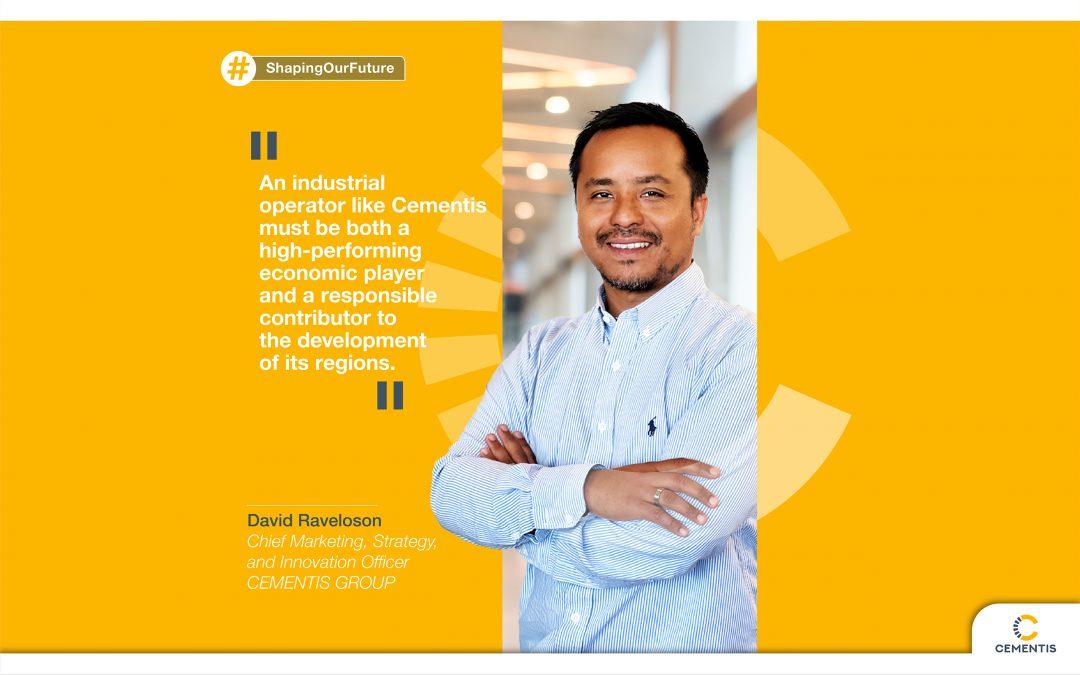
In this context, we firmly believe that an industrial operator like Cementis must be both a high-performing economic player and a responsible contributor to the development of its regions. Our growth is only possible if we fully integrate these environmental challenges. This proximity to our environment demands that we lead by example.
Our vision is built on bold choices. Across our main markets in Mauritius, Reunion, and Mayotte, we have switched to kraft paper bags, whereas many industry players still use polypropylene. This simple shift keeps millions of plastic bags out of our waste streams every year.
Yet, our roadmap goes far beyond packaging. It rests on three key pillars:
- Developing lower-carbon building materials tailored specifically to the unique conditions of our regions.
- Unlocking the value of local resources to reduce our reliance on imports and long-distance transport.
- Accelerating innovation to support the green transition of the entire construction sector.
Our ambition is clear: to establish Cementis as the leader in sustainable building solutions across the Indian Ocean.
What are the Group’s main levers today for optimising the use of local resources and reducing our carbon footprint?
The first essential step was to accurately measure our footprint. In 2024, Cementis became one of the first building materials companies in the Indian Ocean to complete a comprehensive carbon assessment across all its operations. This rigorous process now allows us to pinpoint our primary emission sources (both direct and indirect), our energy consumption, and the logistics footprint of our product transport.
Armed with this data, we have already activated several concrete measures on the ground. We are regional pioneers in incorporating local resources into our binders. By using local fillers (such as pozzolana, ash, or slag), we can formulate blended cements with a significantly lower environmental impact.
In parallel, we are streamlining our supply chain by prioritising maritime transport, which carries a carbon footprint far lower than air freight or long distance road transport, and integrating strict environmental criteria into our supplier selection process.
Finally, our Quality Control laboratory in Reunion and our R&D Innovation Centre in Mauritius work hand-in-hand to design the eco-efficient building solutions of tomorrow, with one constant goal: to reduce our products’ carbon footprint without ever compromising on performance.
How do the circular economy and the upcycling of industrial waste fit into Cementis’ strategy in concrete terms?
The circular economy is a core element of our industrial model. This approach makes perfect sense for island environments where natural resources are finite and waste management is a major challenge.
To give a very concrete example, one of our islands is preparing to launch a highly innovative cement that incorporates fillers derived from recycled concrete slurry. This technical breakthrough will allow us to unlock value from a previously unexploited resource, further lowering the overall carbon footprint of the finished product. For us, the circular economy is a powerful driver of innovation, competitiveness, and local resilience.
Eco-designed cements sometimes raise questions among construction professionals regarding their strength. How do you respond to them?
I completely understand these concerns. In our industry, structural safety, durability, and performance are non-negotiable prerequisites. However, the message I want to convey loud and clear is simple: eco-designed cements are not sub-standard products. On the contrary, they are the result of years of rigorous scientific research, laboratory testing, regulatory certification, and proven on-site performance.
In Reunion, Cementis is currently the only cement manufacturer to offer a CEM V cement incorporating slag or pozzolana. This class of binder has been used in Europe for decades and has repeatedly proven its reliability in the most demanding civil engineering projects.
This specific cement reduces the carbon footprint by roughly 30% while maintaining an exceptionally high level of mechanical performance. Fully CE and NF certified, it features the PM-ES designation (suitable for marine environments and sulfate-resistant). This gives it outstanding resistance to external chemical attacks, coastal air, and the extreme weather conditions of the Indian Ocean.
The ultimate proof lies on-site. Our CEM V has already been selected by the ICADE Group for major residential developments, and it will soon support the construction of the upcoming Lycée des Métiers de la Mer in Reunion. These achievements prove that we can seamlessly reconcile environmental performance with technical excellence.
What are the next major milestones for deploying these innovative cements across the region?
We have ambitious infrastructure goals. With the anticipated resumption of the landmark Nouvelle Route du Littoral (NRL) project in Reunion, we plan to reintroduce a CEM III slag-based cement to meet the client’s highly demanding technical requirements.
Beyond this project, high-performance solutions like this are destined for deployment across other major infrastructure works in the region, such as the Rivière des Anguilles dam project in Mauritius. Every day, our solutions prove that we can fully bridge the gap between the green transition, structural longevity, and engineering excellence.