From testing raw materials to testing concrete poured on site, nothing leaves the Cementis Réunion laboratory without being thoroughly checked, analysed, and pushed to its limits.
At a time when the industry is accelerating its environmental transition, the laboratory has become a strategic vantage point. But how is the role on the ground actually evolving amidst these transformations?
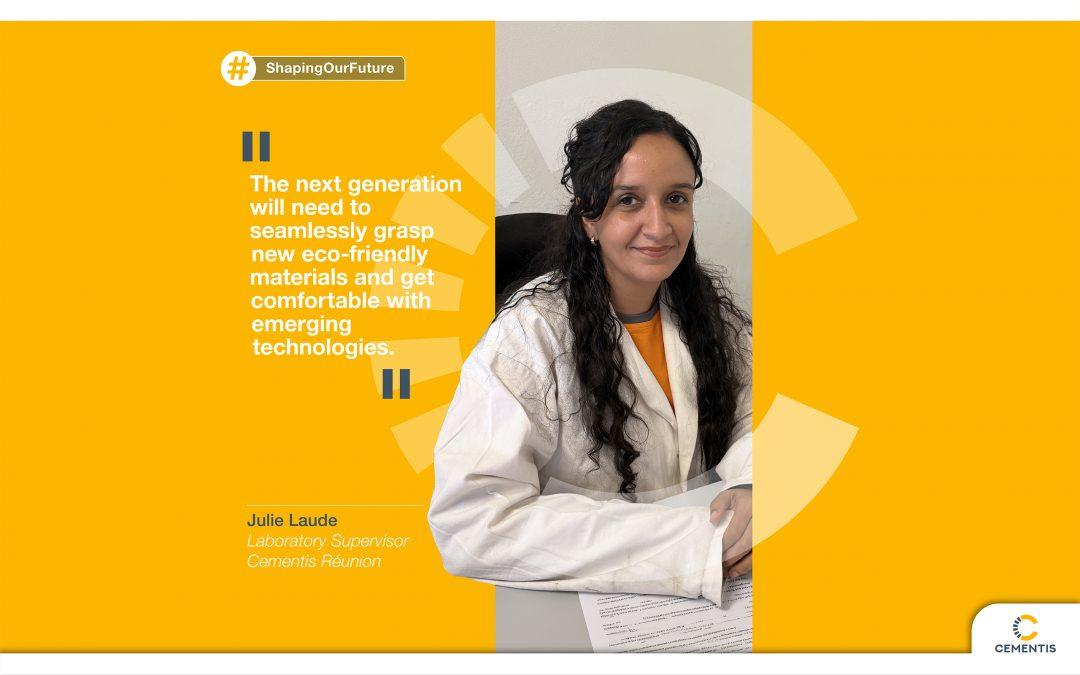
We spoke with Julie Laude, Laboratory Supervisor at Cementis Réunion. She shares how her role has transformed and gives us her take on the skills that will shape the industry tomorrow.
Julie, how did your journey at the Cementis Réunion laboratory begin?
I joined the laboratory in 2015 as an operator, before progressing to the role of technician and then being appointed Laboratory Supervisor in 2021.
Over time, I discovered a remarkably diverse profession and truly came to appreciate the strategic role the laboratory plays. We work directly with raw materials, cements, concrete, and aggregates to carry out all the necessary testing to monitor and refine our solutions. The data we provide gives our production teams the reliable foundation they need to ensure top-tier quality and performance. It’s a role that demands precision, strong organisational skills, and daily collaboration across all departments.
Since you started, what has changed the most in your day-to-day work?
Today, my role focuses heavily on coordinating and streamlining our laboratory activities. I love anticipating needs, planning work schedules with the team, and ensuring every test runs seamlessly. I also really enjoy being involved in onboarding new equipment, as it allows us to continuously modernise and refine our processes.
With the push towards decarbonisation, how have you had to adapt your skills?
Decarbonisation has significantly reshaped the way we work. We are constantly integrating new materials, refining our testing methods, and expanding our knowledge to keep pace with these evolving challenges. It requires continuous learning, genuine curiosity, and a high degree of adaptability. It’s a rewarding shift that pushes us to grow together and constantly expand our technical capabilities.
As a Supervisor, how do you support your team through these changes?
My role is to guide the team through this transition by remaining approachable and supportive. These shifts bring new methods, new tests, and a fresh way of looking at our trade.
I place a huge emphasis on open communication. I make sure everyone has the opportunity to develop their skills, thrive in their work, and understand the true value of their contribution. Everyone plays a part, and it’s by moving forward together that we tackle these new challenges. Naturally, I also ensure that our day-to-day setup allows the team to perform at their best, with safety always taking top priority.
In such a fast-moving industry, how do you keep learning personally?
You learn something new every single day! New projects, state-of-the-art equipment, training courses, and everyday exchanges with colleagues are all fantastic opportunities to upskill. The key is to stay curious, keep an open mind to change, and view learning as a lifelong journey throughout your career.
In your view, which technical skills will be essential for the next generation?
Mastering the fundamentals of the profession will, of course, remain essential, but it will no longer be enough. The next generation will need to be highly agile to adapt to an environment that is evolving at an unprecedented pace. They will need to understand new low-carbon materials, fully embrace the challenges of decarbonisation, and know how to leverage emerging technologies such as artificial intelligence as powerful tools to support analysis, decision-making, and the optimisation of our processes.
Scientific rigour will always be at the heart of the role, but it will need to be complemented by even greater flexibility, responsiveness, and a commitment to continuous learning. The world around us is changing rapidly, so future professionals must be ready to challenge established practices, experiment with new approaches, share ideas, and actively contribute to continuous improvement.
Beyond technical expertise, which human qualities will make the difference tomorrow?
Team spirit, strong organisation, curiosity, and adaptability will be essential. Being able to communicate clearly, share knowledge, and navigate change… those are the human qualities that will enable us to build a sustainable future together.