
Across the Indian Ocean, building means working with a particularly demanding environment. Cyclones, heavy rain, high humidity, sea spray, and climate variations put structures to the test, requiring careful attention from initial design through to final execution.
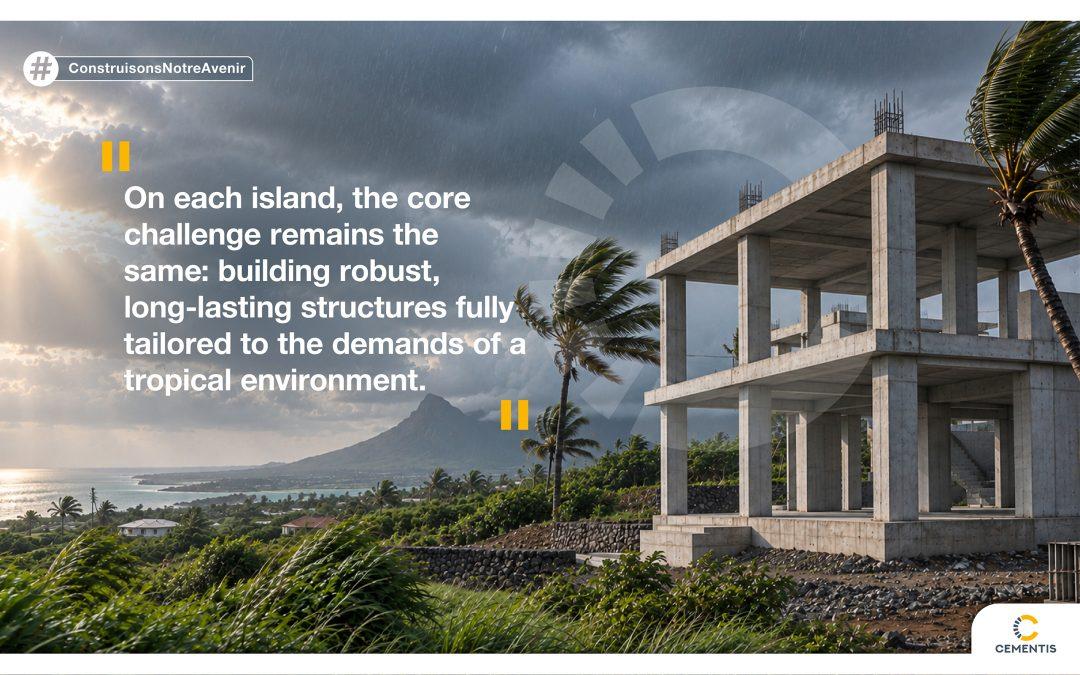
From Mauritius and Réunion to Mayotte, the Comoros, and the Seychelles, each island territory adapts to its own topography, microclimate, and local building traditions. Yet the core challenge remains identical: erecting robust, long-lasting structures fully tailored to the demands of a tropical environment.
At the core of this challenge is the structural framework. Foundations, load-bearing elements, masonry, and concrete form the essential core that ensures a building’s stability and longevity. And at the heart of concrete, cement plays a crucial role.
Structural Integrity: The Primary Line of Defense
When facing cyclonic winds, a building’s resistance relies primarily on structural continuity and its ability to transfer loads safely into the ground.
How this is achieved varies across the islands. In Mauritius, reinforced concrete plays a major role in construction, forming the structural spine of buildings from deep foundations to load-bearing columns and slabs.
In Mayotte and the Comoros, where single-family masonry homes predominate, the critical focus is on execution quality and structural tie-ins. Ring beams, tie columns, and reinforced concrete components help bind the masonry together, ensuring greater overall structural continuity.
In Réunion, decades of cyclonic exposure have sharpened engineering codes and structural design standards. Here, high-strength concrete framing and reinforced masonry are mandatory components, with strict oversight on material specs and site execution.
In the Seychelles, while exposure to direct cyclonic paths differs from other territories in the region, structures remain subject to a harsh tropical and marine environment. The durability of the main structural framework and its ability to withstand humidity and environmental exposure are equally vital considerations.
Cement Quality: The Cornerstone of Durability
To offer such resilience against the elements, concrete leaves no room for guesswork. Its strength relies on the quality of its fundamental component: cement.
A tailored mix design, combined with skilled application, directly dictates compressive strength, water resistance, and overall structural lifespan. Selecting the right binder is carefully determined by the project type, exposure level, and structural requirements.
In a tropical climate, endurance is not measured solely on the day of the storm. Long after it passes, torrential rains, persistent humidity, and aggressive marine air continue their erosive work. That is why building to resist the wind is not enough: we must build to stand the test of time.
This commitment drives CEMENTIS as a regional partner across the Indian Ocean, delivering specialised cements engineered for major civil infrastructure as well as everyday commercial and residential building.
Because lasting structures begin with superior materials, CEMENTIS puts cement quality at the very heart of regional construction.
From cement to concrete, from concrete to structural framework, and from framework to enduring buildings: building in the Indian Ocean means building for today, and for generations to come.
CEMENTIS, shaping our future!